
Iowa Dialing Rules and Phone Codes
Iowa runs on two dialing habits at once. In the eastern 319 region and the central 515 region, a local call takes all ten digits. In 563, 641, and 712, the current numbering records still show seven-digit local dialing as valid. Nothing in that arrangement is a mistake. It reflects how each region's carriers set up their exchanges, and it has stayed that way for years.
Cross from one Iowa region into another and the rule simplifies. Every call between codes takes ten digits, and every toll call takes 1 first. The table below sets out which format applies to which kind of call.
| Call Type | Phone Code Format | Example |
|---|---|---|
| Local inside 319 or 515 | 10 digits, area code included | 515-281-3114 |
| Local inside 563, 641, or 712 | 7 digits still shown as valid | The line number on its own |
| One Iowa region to another | 10 digits | 319-356-1616 |
| Toll call anywhere in Iowa | 1 plus 10 digits | 1-515-281-5011 |
| Toll-free | 1 plus a toll-free code plus 7 | 1-800-248-4483 |
| International, from a landline | 011 plus country code plus number | 011 and the rest |
| Service line | 3-digit code, no area code | 211 |
The habit worth building is simple. Save every Iowa contact in full ten-digit form. That version connects from all five regions, survives a move across the state, and works from a mobile without any thought at all.
N11 Service Phone Codes Used in Iowa
N11 codes are the three-digit shortcuts that bypass ordinary numbering. They carry no area code and no geography of their own. What they reach depends on where you are standing, since each one routes to whatever service is set up locally. Iowa has most of them running, though not all.
| N11 Code | What It Reaches in Iowa |
|---|---|
| 211 | Community services and referrals through Iowa's United Way affiliates; also text your ZIP to 898211 |
| 311 | No statewide Iowa service; available only where an individual city has set one up |
| 411 | Directory assistance, billed by your own carrier |
| 511 | Road, weather, and traffic conditions, paired with the state transportation department's 511 resources |
| 611 | Your phone company's own customer service desk |
| 711 | Telecommunications Relay Service; Relay Iowa also runs a TTY line at 1-800-735-2942 |
| 811 | Iowa One Call, for locating buried lines before you dig |
| 911 | Police, fire, and ambulance for anything happening now |
| 988 | Suicide and Crisis Lifeline, by call, text, or chat |
Note: Iowa has no statewide 311, so non-emergency city business goes to your city hall directly and county business goes to the county office involved.
Two of these codes carry an Iowa detail worth knowing. Calls to 988 are routed by the area code of the phone placing them, so an Iowa number generally reaches an Iowa crisis center even when its owner is traveling. That is helpful for local referrals and unhelpful if you need help where you actually are, so describe your location to the counselor. With 211, some phone systems refuse to pass the short code through at all, which is why the toll-free alternative 866-813-1731 exists.
Star Codes on Iowa Phone Lines
Star codes, known formally as vertical service codes, are instructions to your carrier rather than codes that route a call somewhere. You dial one before or instead of a number, and it changes how the next call is handled. Support is uneven. Landlines carry the widest set, mobile networks handle some of them, and internet-based lines vary by provider.
| Star Code | Action |
|---|---|
| *57 | Trace the call that just came in; usually requires carrier or law-enforcement follow-up |
| *60 | Block specific numbers from getting through |
| *67 | Hide your caller ID on the next call only |
| *69 | Call back the last number that rang you |
| *70 | Turn off call waiting for one call |
| *72 | Switch call forwarding on, then dial the destination |
| *73 | Switch call forwarding off |
| *77 | Reject calls that arrive with the number hidden |
| *82 | Show your caller ID on the next call |
Two of these earn their keep in ordinary Iowa life. Anyone who has received a threatening call should know about *57, because a trace creates a record the carrier can hand to law enforcement, though fees and availability differ by company. And *82 solves a quiet annoyance, since offices that reject anonymous calls will not accept a line with caller ID switched off. Note: fees apply to several star codes on some Iowa carriers, so check your plan before leaning on one regularly.
The Area Phone Codes Serving Iowa
Area codes are phone codes too, just the geographic kind. Iowa uses five of them and none overlap, so each one points at a real part of the state rather than sharing ground with a second code.
- 319 - eastern Iowa, in service since 1947
- 515 - central Iowa and the capital, in service since 1947
- 563 - the Mississippi corridor and northeast Iowa, split from 319 in 2001
- 641 - central and southern Iowa, split from 515 in 2000
- 712 - western Iowa, in service since 1947
The boundaries, the city-by-city coverage, and the split history behind those dates all sit with the Iowa area codes reference. What matters for dialing is only which region a number belongs to, since that decides whether seven digits will connect.
Local Exchange Phone Codes in Iowa
The three digits after the area code are the exchange code, written as NXX and sometimes called the central office code. They are the least visible phone codes on any Iowa number and among the most informative. Each one belongs to a rate center, which is a billing area usually built around a single town, and each was issued to a specific carrier on a specific date.
All of that is public. The NANPA central office code assignment records publish the full file, listing state, code, carrier, rate center, effective date, and whether a code is in service.
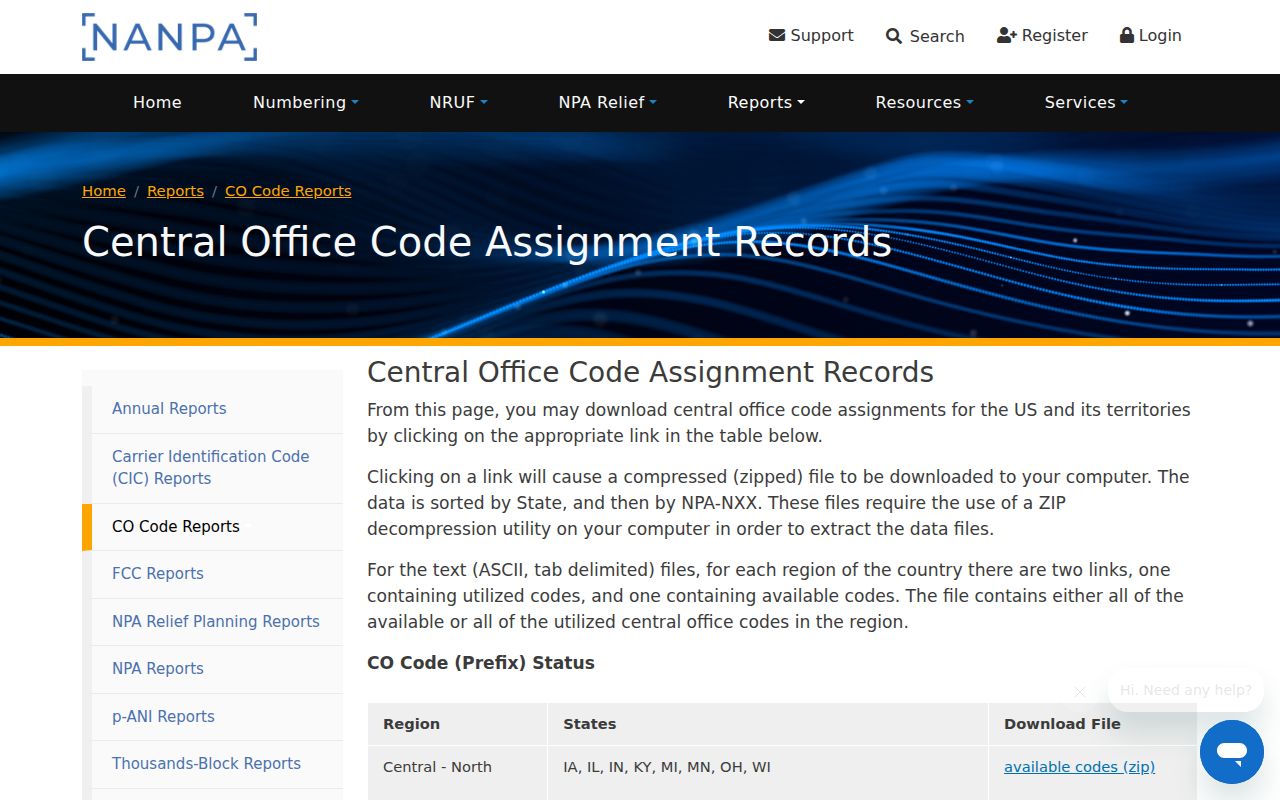
The download is a plain data file rather than a search box, so it rewards patience. Iowa entries show the pattern clearly. 515-281 sits in the Des Moines rate center under Qwest Corporation and turns up on state government lines. 319-335 belongs to Iowa City and the University of Iowa. 563-307 in Dubuque was issued to a wireless carrier, which is a different kind of line entirely.
One caution belongs with all of it. Number portability lets a line keep its digits while moving to a new carrier, so an exchange code proves where a number started and nothing more. NANPA says as much itself, noting the files are not a complete routing or billing record. Using those clues to check an unknown caller is covered on the Iowa phone numbers page.
Toll-Free Codes Iowans Dial
Toll-free codes look like area codes and behave nothing like them. They carry no geography, the called party pays for the call, and numbers are handed out from a national pool rather than tied to a rate center. Iowans meet them constantly, since most state help lines use one. The State Library answers at 800-248-4483 and the abuse reporting hotline at 800-362-2178, neither of which says anything about where the phone actually rings.
New toll-free codes were opened as each earlier one filled up:
| Toll-Free Code | Opened |
|---|---|
| 800 | 1967, the original |
| 888 | 1996 |
| 877 | 1998 |
| 866 | 2000 |
| 855 | 2010 |
| 844 | 2013 |
| 833 | 2017 |
Two other code families are worth recognizing for the opposite reason. Numbers beginning 900 carry premium charges and are blocked on many lines, and the older 976 prefix served the same purpose locally. A separate range, 555-0100 through 555-0199, is set aside for fiction, so a number in that band is never a real office.
International Phone Codes From Iowa
Iowa sits inside the North American Numbering Plan, and the whole plan shares one country code: +1. Iowans almost never dial it at home, because a domestic call does not need it. It matters in two situations. Anyone calling an Iowa number from another country has to include it, and anyone saving contacts for use abroad should store them with it.
Calling out of the state works in a set order:
- From an Iowa landline, dial 011 first. That is the exit code that tells the network the call is leaving the country.
- Add the destination country code, then the local number as it would be dialed there.
- From a mobile in Iowa, replace 011 with a plus sign, usually reached by holding the zero key, then the country code and number.
- To reach an Iowa number from overseas, dial that country's own exit code, then 1, then the full ten digits.
Note: the plus-sign method works on Iowa mobiles whether you are at home or traveling, which makes it the safer way to store any international contact.
Spam Labels on Iowa Calls
The words Spam Risk or Likely Scam on an Iowa phone screen do not come from a phone code at all. They come from a caller-ID authentication framework the FCC calls STIR/SHAKEN. Carriers sign each call as it leaves their network and check the signature when it arrives, which lets them tell whether the displayed number was genuinely authorised by the network it claims to come from.
What the label means is narrow. A verified call is one whose caller ID passed that check, not one from a trustworthy person. A legitimate Iowa business can be flagged because of how its calls are routed, and a scam call can slip through with clean paperwork. The FCC caller-ID authentication page explains the mechanism and its limits. Spoofing an Iowa area code remains cheap and common, so a familiar-looking 515 or 712 number on your display proves nothing on its own.
Phone Code Definitions
The vocabulary around phone codes gets used loosely, so here is what each term actually means.
- NPA
- Numbering Plan Area, the formal name for an area code. Iowa has five.
- NXX
- The exchange code, meaning the three digits after the area code, tied to a rate center.
- N11
- A three-digit service code such as 211, 811, or 988 that routes outside normal numbering.
- Vertical Service Code
- A star code that instructs your carrier rather than dialling anyone.
- Toll-Free Prefix
- A non-geographic code, such as 800 or 833, where the called party pays.
- NANP
- The North American Numbering Plan, the +1 region that Iowa belongs to along with the rest of the United States, Canada, and 23 other territories.
How to Verify an Iowa Phone Code
Two sources cover almost every phone code question an Iowan will have. The numbering administrator publishes the working data: area code assignments and their dialing plans, exchange code records, and the status of every code in the state. The FCC publishes the policy side, including how codes are assigned and what the authentication rules require of carriers.
Neither source explains star codes, because those belong to the carriers rather than the numbering system. For those, dial 611 and ask your own provider which codes your line supports and what each one costs. Note: the numbering data is republished regularly, so check the current file rather than an older copy before relying on a dialing rule.